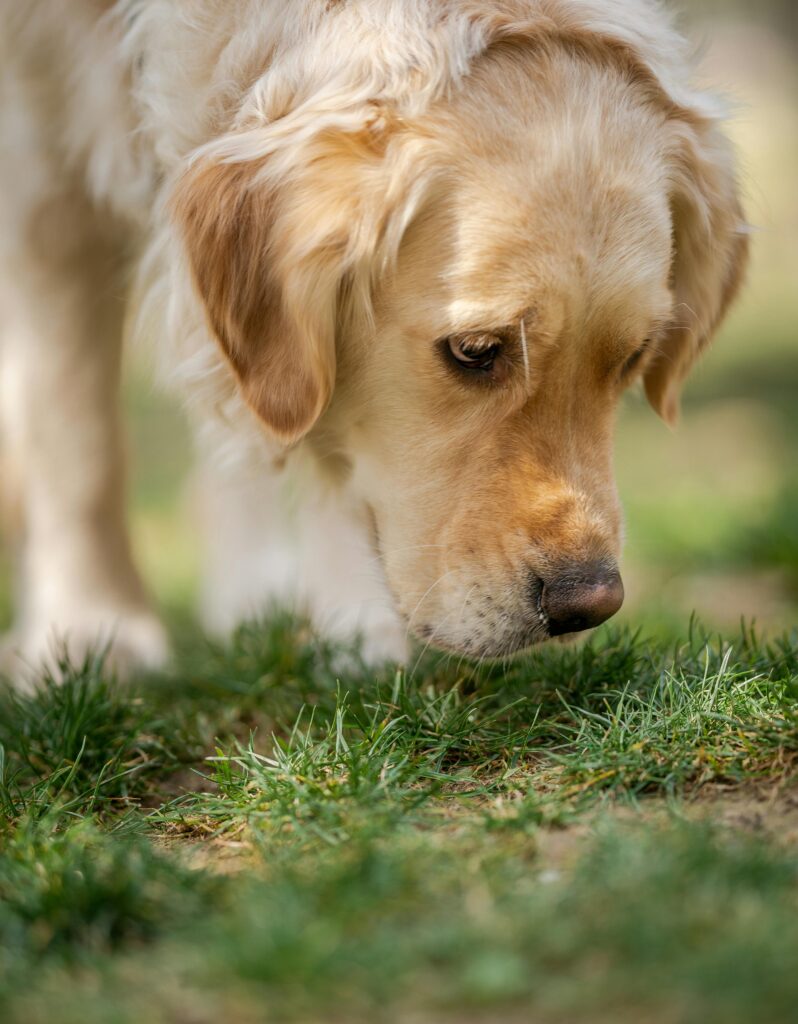
Do you ever feel like your daily walk is more of a “stop-and-sniff” session than a workout? If you’ve ever wondered, why do dogs sniff everything?, you’re about to discover a hidden world of communication. For dogs, a single sniff provides a wealth of information that we can barely imagine. In this guide, we’ll explore the incredible science behind your dog’s nose, from the “social media” of fire hydrants to how sniffing can actually help calm your pup’s anxiety.
If you’ve ever taken your dog for a walk, you know the feeling: you’re ready for a brisk exercise, but your dog wants to stop and investigate every single blade of grass and fire hydrant. While it might seem like they are just being stubborn, your dog is actually “reading” the world. For a canine, sniffing is more than just a sense—it’s how they process information.
A Super-Powered Sense of Smell
To understand why they sniff so much, you have to look at the hardware. Humans have about 5 million olfactory receptors in our noses. Dogs? They have up to 300 million. Additionally, the part of a dog’s brain that analyzes smells is, proportionally, 40 times larger than ours. When they sniff, they aren’t just smelling “grass”; they are smelling who was there, what they ate, and even how they were feeling.
The Jacobson’s Organ (Vomeronasal Organ)
Dogs have a special “second” smelling system located in the roof of their mouth called the Jacobson’s organ. This organ is specifically designed to detect pheromones—chemical signals that animals leave behind. This allows your dog to “taste-smell” chemical messages that tell them if another dog is a friend or foe, or if a female is in heat.
Reading the “Pee-mail”
In the US, trainers often joke that hydrants and light poles are the “social media” of the dog world. When your dog sniffs where another dog has urinated, they are checking their “inbox.” They can tell the age, gender, health status, and even the stress levels of the dog that was there before them.
Mental Stimulation and Relaxation
Sniffing is hard work for a dog’s brain. In fact, 15 minutes of sniffing is often more tiring than an hour of walking. Engaging their nose lowers their heart rate and reduces stress. This is why many behaviorists in the US now recommend “Sniffaris”—walks where the dog is allowed to lead with their nose and stop as often as they like.
Identifying Their “Pack”
When you come home and your dog sniffs your shoes or legs intensely, they are performing a “security check.” They are learning where you went, who you were with (did you pet another dog?), and even if you stopped at a burger joint on the way home.
You may also like: [Why Do Dogs Howl? 5 Fascinating Reasons Behind the Noise]
[Why Do Dogs Wag Their Tail? Understanding Canine Body Language]
[Why Do Dogs Dig? Understanding the Instinct and Saving Your Yard]
Leave a Reply